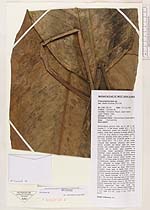
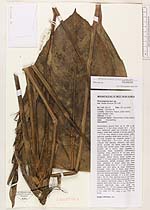
| Field notes | Rhizomatous ground herb, up to 198 m tall. Leaves 2 - 4 per shoot; sheath 56.5 - 76 cm long, distichous, green but brownish in wing, papery, white hairs, sparsely to dorsal; petiole 35 - 47.5 cm long, ellipse in cross section, green, glabrous, sparsely white hairs; pulvinus 10 - 12 cm long, purplish red, brownish yellow in old leaf; lamina 65.5 - 70 x 12.5 - 30 cm, ovate, unequal side laterally, discolour, light green above, purplish red below, base red, upper primary vein whitish green, lower primary vein purplish red or brown, apex cuspidate to acuminate, basis equilateral. Inflorescence interfoliar, erect; peduncle 97 cm long, white hairs, panosse or tomentose; synflorescence elongated, lateral branch which contain the flower 11 cm long, green to reddish brown; bract (unmeasured), spirally arranged, green when fresh, yellowish to brown when dry, base yellowish, fertile bract 4.7 x 2 cm, lanceolate, green and next same as bract, distichously arranged, inner side of fertile bract there's transparent bract 18 x 6 mm, lanceolate; flower 2 pairs per special paraclade. Flower white, c. 6.2 cm long; sepals subulate, 27 x 4 mm; corolla tube c. 43 mm long; staminal tube 4 mm longer than corolla tube; corolla lobes lanceolate, 18 x 5 mm; petaloid staminode lobes 2, the first free petaloid staminode lobe 29 x 2 mm; the second petaloid staminode lobe with small trig appendage 25 x 23 mm: petaloid appendage 14 x 2 mm: cucullate staminode 4 x 2 mm; stamen 4 mm; style 3.5 mm; ovary 5 mm. Fruit: not found. Uses: Food packing. V.n. Wasirambau (Onate dialect). |
 This record
 Other records of Phrynium giganteum