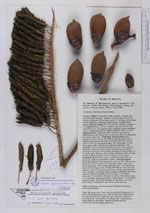
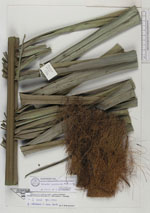
| Field notes | Solitary. stem 0-6 m tall, 50-100 cm diam., covered with persistent leaf sheathes. Leaves 15-20, arching; sheath and petiole continuous, 80 cm long; rachis 6-7 m long, ca 8 cm wide at base, tapering, channeled-ridged above, rounded below, green, glabrous; pinnae 205-221 per side, basally in groups of 1-2, separated by ca. 20 cm, distally in groups of 5-6 (-10), separated by ca. 5 cm, pinnae green, glabrous, midrib triangular in x.s., conspicuous above; middle pinnae 84-102 x 3-4 cm. Inflorescences, unisexual, both staminate and pistillate inflorescences normally present on the same plant, but apparently not at the same time. Staminate inflorescences erect: prophyll ca. 40 x 15 cm, very fibrous, apically dissolved in a fibrous mesh; peduncular bract acuminate, 105-108 cm long, with a 16-26 cm long beak at apex, 38-59 cm diam., 3.5 cm thick, green with a thin brown, caducous indument, with numerous 1.5-2 cm deep longitudinal furrows, bract splitting abaxially, still partly enclosing the inflorescence at anthesis, opening reaching ca. 10 cm width; peduncle ca. 36 cm long, 2.5 cm diam. apex; rachis ca. 40 cm long; rachillae ca. 260, all more or less of the same size, 10-14 cm long, ca. 3 mm diam. Staminate flowers first cream, petals becoming violet on exposure, stamens and anthers yellow. Infructescences recurved, hanging down along trunc; peduncle 65-100 cm long, flattened, 5.5-8 cm wide, 3.5-5 cm thick, green, with a thin brown indument, with several rudimentary, to 3 cm long bracts; rachis 60 cm long or more. Fruits 350-500 per infructescence, obovate, angular from mutual pressures, rostrate, greysh-green when immature, becomong yellow-orange at maturity, with a thin caducous brown indument, 6.5-8 cm long, 4-5 cm diam.; mesocarp 7-8 mm thick, divided in an outer, hard, fibrous layer, ca. 4 mm thick, and an inner fleshy, yellow layer, 3-4 mm thick; endocarp thick, very hard, elongate, 35 mm diam., ca. 6 mm thick; seeds 2, separated in two rooms in the endocarp. Commonly cultivated around Caranavi and Guanay. Local name: Motacu. Uses: Mesocarp eaten, fruits sold in market of Guanay for 2-3 cents each, depending on size. Oil extracted from kernels used for engreasing the hair, baby skin-care, and given orally for lowering fever. Oil sold for 15 USD per litre. Leaves used to make shelters in the fields. midrib of pinnae used for patchwork, and for making hand fans |