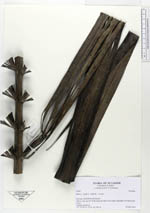
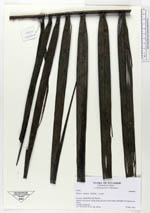
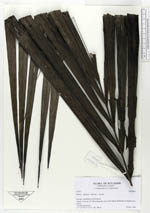
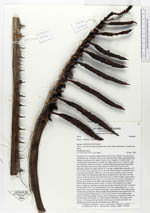
| Field notes | Growing in a very muddy swamp along a small rivulet. Solitary, the individuals separated by 20 - 40 meters. Stem to 6 m long and 40 cm diam., procumbent and bending, ascending for the apical 2 meters or so, irregular on surface from 5 - 10 cm protrusions at leafscars, but mostly not visible because it is covered by litter and vegetation. Below the crown to 1 m long leafbases remain and these and the bases from fresh leaves form a big clump covered in litter. Leaves ca. 40, spreading, sheath not visible. Petiole ca. 3 m long, rounded below flat above, 10 - 15 cm wide at base, tapering to ca. 5 cm wide below the blade, the margin with 1 - 2 cm long curved hooks. Rachis ca. 5 m long, green smooth, except in young leaves where it is furfuraceous light brown, rounded below, the top has two flat sides on which the pinnae are inserted and a flat or slightly bulging toppart that is as wide as the petiole at the base ( ca. 5 cm) but narrows upwards to disappear ca. halfway up the blade so the upper rachis becomes a ridge consisting of the two laceral sides bearing the pinnae. Pinnae ca. 90 per side, arranged in one plane, linear, reduplicate, tapering to a narrow tip, the tips sometimes laterally connected, the basal pinna 50 x 2 cm, middle pinna 120 x 6 cm, apical pinna 50 x 1. 5 cm. Inflorescences male and female on same plant, both interfoliar. Male inflorescence with the base enclosed in a fibrous prophyll and peduncular bract; peduncle ca. 80 cm long (estimated), flattened, 4 x 5 cm in cross section, brown furfuraceous; rachis 25 cm long, tapering to the tip, brown furfuraceous. Rachillae standing out in right angles to the rachis, ca. 100 in number (estimated), 20 cm long at the base, 6 - 7 cm long at the top. Female inflorescence on shorter peduncle, not standing out from between the leafsheaths as the male one. |
 This record
 Other records of Elaeis oleifera