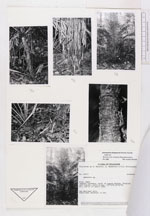
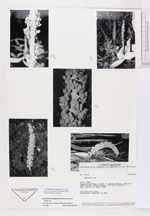
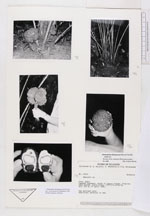
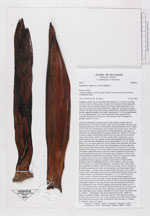
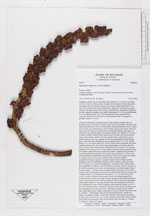
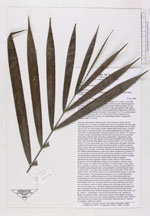
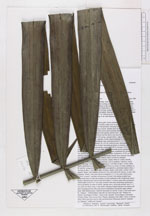
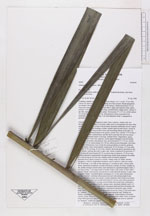
| Field notes | Cespitose, usually only two develops. Stem absent or to 1 m tall, 12 cm diam. Leaves 12, erect in a dense rosette coming out of the ground. Sheath and petiole not distinct, the base (sheath) fibrous at the margin, sheath and petiole 275 cm long, base rounded below flat and black above, upper part (petiole) terete, green, smooth, 2 cm diam. Rachis 300 cm long, rounded below, ridged above. Pinnae 47 per side, opposite, arranged in one plane. Basal pinnae 57 x 0.5 cm, middle pinnae 72 x 6 cm, apical pinnae 18 x 2 cm. Infructescence borne at ground level, interfoliar. Peduncle 25 cm long, 4 cm wide flattened, fruits 7, arranged in a globular clump 11 x 10 cm. Dioecious, pleonanthic, understory palm. Stem cespitose, usually only two developed, up to 1 m long 12 cm diam, either erect or procumbent, but more often appearing acaulescent, covered with persistent decaying leafsheaths, brown, ringed; leaves 12-20, erect and forming a rosette; sheaths open on outer leaves, closed on inner leaves, 25 cm long on inner leaves and becoming fibrous at the apex, on outer leaves not distinguishable from petiole; petiole (incl. sheath) 2.75 m long, 2 cm diam at middle, rounded below and flat above near base but soon becoming terete, green, smooth; rachis 3.0 m long, rounded below, ridged above, green, smooth; pinnae 47 per side, opposite, evenly spaced arranged in one horizontal plane; with prominent submarginal veins, proximal pinna 57 x 0.5 cm; middle pinnae 72 x 6 cm, apical pinnae 18 x 20 cm; inflorescences dimorphic, interfoliar, staminate inflorescence erect in bud, becoming pendulous at anthesis; peduncle fleshy, creamy white, dorsiventrally compressed, 40-75 cm long, 3-3.5 cm wide; prophyll 31-53 cm long, 4-6 cm wide, smooth, brownish-green, persistent in leaf axil, tubular, splitting abaxially at apex only, adnate to peduncle for proximal 5-7 cm; peduncular bract inserted 22-33 cm above base of peduncle, 35-50 cm long, splitting abaxially longitudinally not abscissing cleanly from peduncle but adnate to it and leaving an un even scar, whitish where covered by prophyll, greenish-brown where exposed on outside, creamy white on inside, smooth, ancipitous, with few longitudinal striations, erect at anthesis, caducous; rachis 40-70 cm long, 3 cm wide at base tapering to 1 cm diam at apex, creamy white, fleshy, pendulous at anthesis, covered with floury or mealy covering; rachillae ca. 60, spirally arranged around rachis, each subtended by a prominent papery bract, 3 cm long at abse, 1 cm long at apex of rachis, fleshy, with scales, at base with 6 angular "heads" each densely covered all over with yellowish stamens, at apex with 2 angular "heads", each head almost rectangular 2 x 1.5 cm; male inflorescence scented "coconut", pistillate inflorescence (in bud) with similar prophyll and peduncular bract as male (but smaller, in bud); peduncle with 8 small acute bracts at apex; infructescence erect in leaf axil; fruits 4-7, brown, each with a prominent central spike (style?) to 4 cm long, covered with warty projections, projections not so prominent on sides or below; epicarp warty, mesocarp whitish; seed 5 x 3 cm; seed coat black, bony, 1 mm thick; endosperm liquid and then becoming rock hard, homogenous but with some brown ruminations around the edge; embryo basal. Male inflorescence visited by thousands of weevils. Fruits (?) and seeds eaten by "watusas". "Yarina blanca" may also be found along the trail "Saladero de Dantas" according to Froilan. 1 hours walk. Spanish: Yarina blanca (Victoriano Criollo). Soina: Tú-te-se-wa. Uses: Thatch, immature fruit edible. Fibers of petiole (inner fibers) previous used to take out beard hairs. Mesocarp eaten by "guatusa" (or "huatusa), "ardilla and "guanta". |
 This record
 Other records of Ammandra decasperma