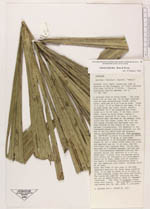
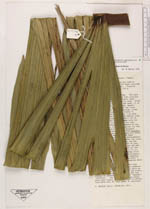
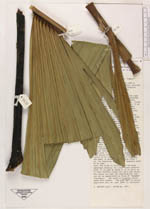
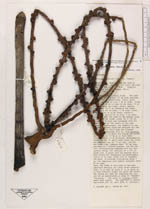
| Field notes | Quichua: "Patihua". Spanish: "Pambil". A solitary tree on terra firme. The base with a 60 cm wide and 100 cm high inverted cone of many black adventitious, spiny roots, each one to 4 or 5 cm in diam. The trunk 13 m long 19 cm in diam at the base, 15 cm in diam near the crown, brown smooth; internodes 10-15 cm long below the crown. Crown on a 120 cm long, 17 cm diam crownshaft, which is olive green. Six spreading leaves; petiole 50 cm long, 5 cm wide, channeled basally, round near the blade; the blade 360 x 160 cm with pinna on each side, the pinnae divided and fanshaped with the base twisted on the rachis so the leaf becomes 3-dimensional, the segments of the fanshaped pinna, rigid and straight all the way to the tip which from the distance easily distinguish this from the Socratea sp (4832) in which the pinna are softer and the apical 10 cm or so bend down. Inflorescences 10 at different developmental stages at the 10 upper nodes below the crown, the smallest one ca 10 cm long, the 8th bullhornlike, hanging down, 130 cm long, enclosed in 5 visible spathes, the 9th and 10th expanded with all the spathes dropped, peduncle 20 x 4-5 cm, brown with 16 scars from the spathes which have dropped throughout its developments; rachis 22 cm long, green, with 25 branches, the lower 14 ones bifurcating after 5 cm, the remaining ones simple, branches about 80 cm long. Uses: The trunk of this palm is the most important material for local house construction, it is used as poles, and split up to form flexible planks for floors and walls. The leaves are used for thatching but they are not as appreciated at those of "canambo" (= Attalea). The roof of Iriartea leaves need more layers. The palmhart is edible. Duplicates: NY, QCA, AAU, QCNE, K, Latinreco. |
 This record