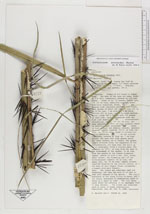
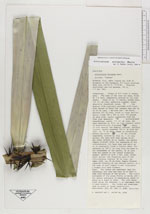
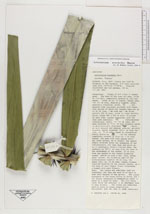
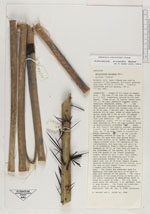
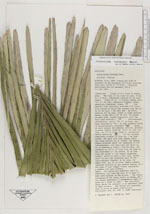
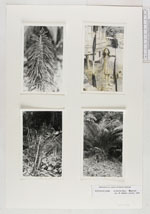
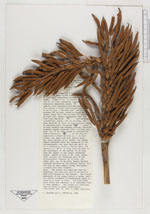
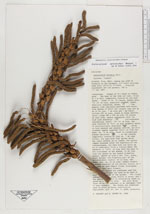
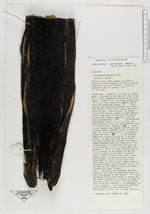
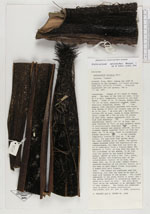
| Field notes | Quichua: "Usahua". Caespitose. Clumps of 4-5 trees in swampy area. Base not seen, the leafbases all the way to the ground. Trunks to 3 m tall, completely covered with old leafbases. Crown of ca 10 leaves; sheath open 130(+) cm long, abaxially rounded, green, adaxially channeled, brown, the other side copiously provided with black flat spines, the largest ones to 20 cm long 7mm wide and 1 mm thick; petiole 200 cm long, round in cross-section, spiny; blade 580 x 200 cm with 105 pinnae on each side, rachis tri-angular with flat side abaxially. Inflorescence intrafoliar, erect, 170 (+) cm long, the base sheathed by 70 (+) cm long prophyll, which is dorsiventrally flattened, spiny on abaxial and adaxial outside, apically rounded, spathe inserted 100 (+) cm from the base, ca 75 cm long, rounded in cross-section before dehiscence, on the outside completely covered by fine ca 1 cm long spines, towards the top the spines are up to several cm long, flattened, the spathe remaining attached after expansion of the inflorescence but hanging down and splitting up to a fibrous mass, peduncle 100 (+) cm long up to the spathe, 30 cm from the spathe to the lowest flower, smooth or with a few flat, short, brown spines; flowering part 40 cm long, 20 cm wide with a central rachis on which the female flowers are inserted, from the base of each of these originates a male inflorescence with many flowers. Uses: Leaves sometimes used for thatching, but hard to work with because of the spines. The liquid endosperm from the young fruits is eaten and the spongy endospermof the germinating seed is eaten as a snack by the kids. The oily white layer below the endocarp is an important food to many animals. The trunks are sometimes used as poles in house construction. |
 This record