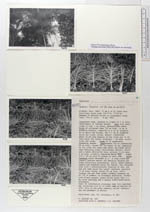
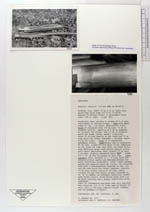
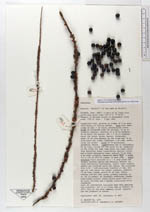
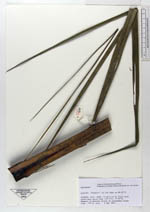
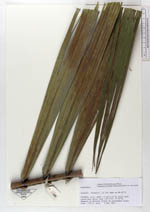
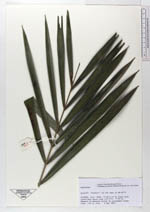
| Field notes | Spanish: "Palmito". Caespitose tree growing in clumps of 5 or more individuals of varying height. Base with small clump of red, 1 cm thick, adventitious roots. Trunk 720 cm high, 14 cm diam basally, tapering to 8 cm diam at 40 cm and 7.5 cm apically, brown, smooth; internodes about 35 cm long basally and 10 cm long apically; leafscars 1 cm wide. Crown of 10 spreading gracious leaves. Leafsheaths red to castaneous, 80 cm long, closed for the basal 50 cm, remaining for some time of ?? the blade falls, then dehiscing along longitudinal a??axial suture? and basal abscision zone; petiole 10 cm long, 4 cm wide, slightly channeled above blade 310 x 130 cm with 59 pinnae on each side. Inflorescences first enclosed in 1 m long round and pointed spathe and emerging between the basal pernisting leafbases, erect; later without spathe and inserted below the leaves, collected tree with 3 inflorescences inserted at 2nd, 3rd and 4th node below lowest leafbase, peduncle 16 cm long, brown; rachis 60 cm long, white turning red and then green; 1 x branched with up to 120 branches; flower buds bright purple; flowers light purple; young fruits green with 0.5 m thick pericarp and greasy clear-whitish endosperm. Uses: No information available when this specimen was collected, but if this is the same as no HB4273, this is the palm commonly called "palmito" and the palmhart is edible. |
 This record
 Other records of Prestoea acuminata