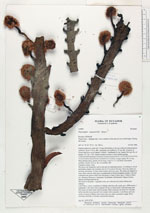
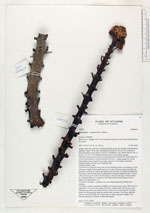
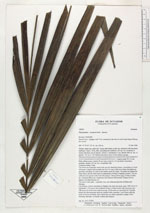
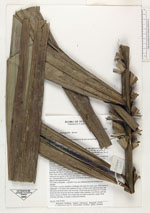
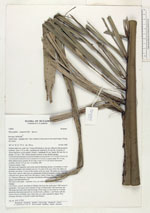
| Field notes | Solitary palm-tree, male ind. Young individuals as the one collected with persistent leafbases. Stem 1.70 m, dbh. (including the leafbses!): 65 cm. No. of leaves: 8 (Some had been cut for thatch). Petiole + leafsheath 41 cm. Rachis 494 cm. No. of pinnae: 137 cm + 129. Pinnae inserted in more or less distinct groups (10;6;4;6;5;6;4;4;4;6;6;5;5;4;6;3;5;3;4;6;4;4;3;4;2;3;2;4;1;5;7;2;3;2;2;3;3;4;3;5;4;5;3;3;3;2;6;4;5;4;6;3;5;3;4;3;3;4;4;4;5;2;3;3;2;4;1). Largest pinae 94 x 6 cm. Male inflorescence: petiole 56 cm long, ovate 6 x 3.5 cm below lowermost rachillae. Rachis 125 cm. No. of rachillae 260. Common noame: Cade. The leaves are frequently used in the area for thatching houses. According to a local informant a thatch will normally last for 5-6 years in the area where the palms are growing, and about 15 years in the nearby more dry areas. The palms are planted in some areas, and are often seen as components of mixed cropping systems. The one collected were grown with Corn (Zea mays), Citrus (Citrus spp.), Coffee (Coffea sp.), Bananas (Musa sp.), Sugarcane (Saccharum officinarum), Papaya (Carica papaya) and Bignoniaceae sp. The seeds of the palm - vegetable ivory, are collected and sold in Manta and Jipijapa. Luis Pionce, a local. merchant in Jibijaba who buys the seeds, pays 1000 sucres (1 leafsheath = 315 sucres )for a Quintal (45 kg.) of dried seeds with mesocarp, and 500 sucres for fresh seeds with mesocarp. Fresh seeds are sun-dried for 3 months before the thin mesocarp-shell are cracked with a machete. Luis Pionce sells the seeds to buyers in Manta, from where they are either exported to Japan, West Germany and Italy, or locally worked into buttons. org. no. AAU 67303 |
 This record
 Other records of Phytelephas aequatorialis