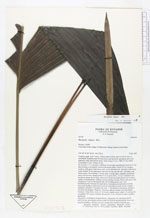
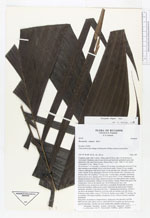
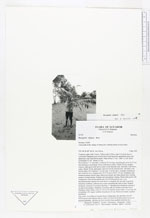
| Field notes | Cespitose palm with 5 stems. Tallest palm 4.30 m, stem 3 m from base to crownshaft. Basalmost part of stem brown and furrowed, apicalmost green and glaborous with some brown areas. Diam at bse 2.7 cm. DBH 2.2 cm, below crownshaft 5.5 cm. Nodes 0.2 cm. No of leaves: 7 + 1 juvenile. Leafsheat 32 cm long, encircling the stem for 27 cm thus forming a crownshaft. Green with brown scales. Petiole 30 cm, straight - concave, dark green with brown scales on the abaxiale side. Abaxially with brown scales. Rachis 78 cm, dark green, furrowed on the adaxiale side. Abaxially with brown scales. No of pinnae: 7 on one side, 5 on the other, irregulary distributed and of uneven size, ranging from 57 X 12 cm to 50 X 2.5 cm. Destalmost and basalmost pinnae always large, inbetween always one large pinnae and a varying number of small pinnae. Distance between pinnae varying. Pinnae dark green with conspecious veins on the adaxial side. No of inflorescence one + one bud.Inflorescence inserted one node below crownshaft, the bud still covered by lowermost leafsheet. Inflorescence nearly encircling the stem at base. Prophyl decideous. Inserted 1.5 cm above the base. 1´´sheeting bract decideous, inserted 1 cm above the prophyl. Peduncle 4 cm long with two minute scale-like bracts. Peduncle cremy-white, ovate, 0.7 X 0.6 cm. Rachis cremy-white 7.5 cm long. No of rachillae: 30 Longest rachillae (basalmost) 12 cm. Flowers in triads, regularly distributed. Etno notes: According to Joaquin Bustos, Pañacocha, this specimen and BH 60479 are the same species and are called HUASAI in quishua and the leaves are used for thatching - and they are more durable than canambo (scheelea sp.) |
 This record