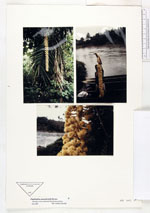
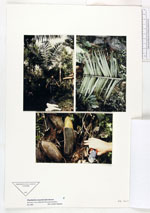
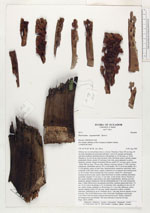
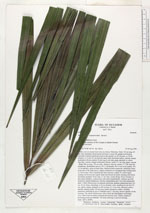
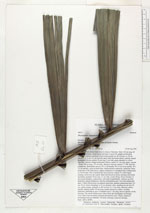
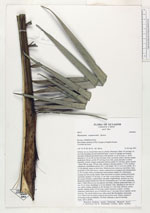
| Field notes | Solitary tree on cleared land close to a house. Dioecious. Stem 150 cm long, 50 cm wide (including old persistent leaf bases. Leaves 24, upright and bending outwards; leafbases persistent down to the ground, ca. 45 cm long, ca. 30 cm (basally) to 16 cm (10 cm from the base) wide; brownish-yellow, smooth, margin moderately fibrous; petiole 30 cm long, 6 cm wide, green adaxially to yellow abaxially, smooth, margin moderately fibrous; rachis 517 cm long, green, smooth . Blade 540 cm long, 170 cm wide, oblong to obovate; pinnae 2 x 10⁴, insertion reduplicate, distribution uneven, 59 x 3 cm basally, 96 x 6 cm in the middle, 28 x 1.4 cm apically, green on both sides. Infructescences numerous, interfoliar, borne at the base of the older leaves, carpels condensed on a receptacle thus forming head ca. 30 cm diam. Parts of peduncular bract remnant, carpels 20, wilted tepals sticking out between the carpels. Male bud (found on nearby standing individual), interfoliar, prophyll 70 cm long, 11 cm wide, woody fleshy, brown (basally) to dive-green (distally), exposed part with splits longitudinally, splitting up at the distal end, margin chartaceous with the nonsheathing part 2 cm wide; peduncular bract 1. Male inflorescence (at anthesis) interfoliar, pendent; peduncular bract 110 cm, 16 cm (where sheathing) to 23 cm (distally) wide, sheathing for the first 50 cm, yellow-orange; peduncle ca. 80 cm long, 6 x 3 cm wide, flattened, yellow, smooth, shining; rachis 145 cm long, cream-coloured to yellow; rachillae numerous, branching in up to 4 branches up to 7 cm long, flowers apically on the branches. The whole inflorescence with a smell like Phytelephas microcarpa. Uses: Fibres from the rachis extracted and used for roofs. Watery content of developing seeds are drinkable. The bony endocarp is used for carvings. Dupl.: QCA, QCNE. |
 This record
 Other records of Phytelephas aequatorialis