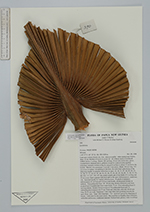
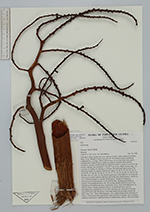
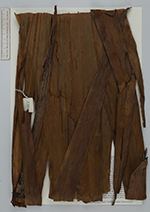
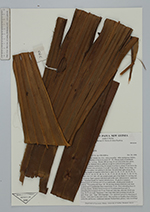
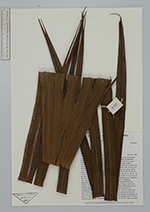
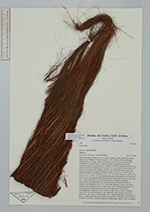
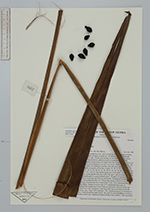
| Field notes | Cultivated solitary female tree, 8 m , stem covered by white crustaceous lichens, diam. 25 cm. Number of leaves in crown 22 - 29. Fibrous mesh of leafsheath reddish brown, 1 m long. Petiole 180 cm long, 19 cm wide at the base, green, rounded below, flattened above, glabrous except for scattered white lepidote tomentum, minutely teethed along the margin from base to about 75 cm below the hastula. Hastula very prominent, 2 cm tall, 5 cm across. Blade 180 cm long, 143 cm across in outline, not splitting to the base, the individual splits being of the following lengths in sequence from base to apex: 24, 36, 23, 27, 28, 29, 30, 33, 34, 36, 37, 41, 42, 43, 45, 48, 52, 53, 56, 57, 61, 62, 64, 66, 68, 71, 80, 87, 92, 99, 104, 111, 113, 120, 127, the central unsplit part of the blade 113 cm long and 55 cm across. Each segment with short split at the apex. Inflorescences numerous, 10+, branched basally in 3 partial inflorescences. Prophyll of immature inflorescences 42 cm long and 12.5 cm wide basally, disintegrated distally at anthesis. First peduncular bract 40 - 45 cm long, distance between scars from prophyll and 1'st peduncular bract respectively 12 cm. First subtending bract 31 cm long tubular, distance between scars of 1'st peduncular bract and 1'st subtending bract respectively 13 cm. Fruits red when ripe, obovoid. 55-65 mm long, 50-55 mm wide. Numerous 3 mm long white lines pointing towards the apex. Nom. vern.: "Suru" (Olo language). Use: preferred species for thatching of houses. Cultivated for the same reason. Also used for axe handles, base of houses, umbrellas and brooms. Additional material: Pickled fruits, photos, video recordings. |
 This record
 Other records of Saribus surru