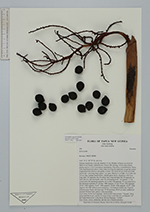
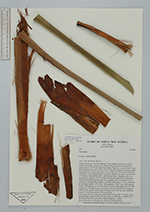
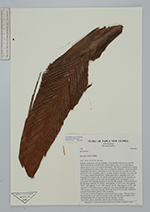
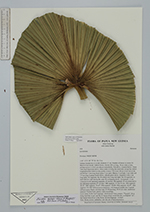
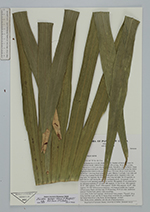
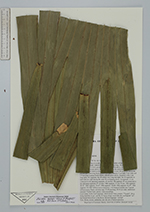
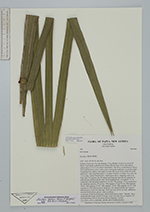
| Field notes | Solitary female tree,12 m tall, diameter 17 cm. Number of leaves in crown 24. Mesh of leaf sheath reddish brown. Petiole 200 cm long, 10 cm wide at base, getting narrow (1.5-2.5 cm) almost immediately. Flat above, rounded below. Green with small black dots above, white scales covering the underside, except the central longitudinal line which is only partly covered. The lower 40 cm of the rim of the petiole has 1 mm long black spines 1 cm apart. Hastula 3 cm high, 3 cm wide and 1.5 cm long. Lamina bluish below, whitish green above. Segments with 2 cm long splits. 64 segments, the 20 central ones long and rigid, the 20 segments on each side less rigid having the outer 30 cm hanging down. 1st segment: 11 cm connected to the adjoining segments, 61 cm free. 5th segment: 15 cm connected to the adjoining segments, 67 cm free. 10th segment: 17 cm+72 cm. 15th segment: 20+81. 20th segment: 23+87. 25th segment: 35+90. 30th segment: 61+97. 32th segment: 61+100. Inflorescences numerous, +10, branced basally into 3 partial inflorescences. Fruits red when ripe, 35-40 mm long, 40-45 cm wide. Additional material: Pickled fruits, photos, video recordings. Local name: In the local language, which doesn't have a name: "Tin-göö", the g being hard like in get, and the öö being a long vowel like the i in English "sir", but formed deep down in the throat. Bewani language: "yu bral". Uses: Bows, rooves, umbrellas, salt (the ash of burned petioles). |
 This record
 Other records of Saribus tothur