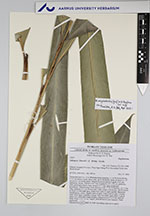
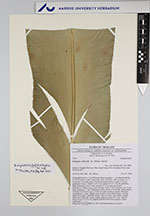
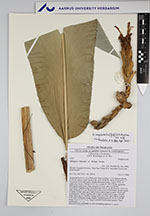
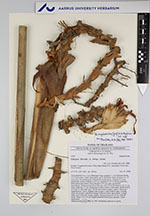
| Field notes | Terrestrial herb in loose clump (c. 30 cm between shoots). Leafy shoot to 8.5 m long. Base of leafy shoot to 1 1 cm diam., brownish green. Sheath brownish green with orange-brown margin. Ligule to 2 cm long, entire,brownish. Petiole to 5 cm long. Lamina to 115 x 28 cm, dark green, finely plicate, base oblique. Inflorescence from rhizome. Peduncle horizontal-ascending-to erect, to 38 cm long, 0-25 cm above ground, slender or stout (1-2 cm diam.); scales cream to orange-brown, margin brown. Receptacle to 16 cm long. Spike to 6-18 x 7-9 cm, numerous flower, 1-7 open at a time. Bract and bracteole orange-brown. Calyx reddish, shiny orangebrown pubescent. Ovary densely orange-brown pubescent. Corolla tube pale yellowish, lobes pale red. Stamina! tube pale yellowish orange. Labellum pale orange. Stamen and stigma pale orange. Infructescence to 18 x 13 cm, with 1-46 fruits, sometimes laterally branching. Fruit to 4 x 3 cm, ellipsoid, verrucose, green to pale red when young - bright orange when mature. Aril orange, sweet but waxy not juicy. Seeds dark brown. Vernacular name: dakal (Waskia language; name only referring to the fruit). Young fruits eaten as substitute for betel (Areca catechu; leaves used for munu (wrapping food in ground oven). Informed by local companions); mas (Kawai language). Used for betel substitute. Informed by Simon Sennart from Siassi Island. Fruit is eaten by bandicoots. Same a Millar NGF 37746 from same locality. |
 This record